
What Is Auto-QA (Automated Quality Assurance)?
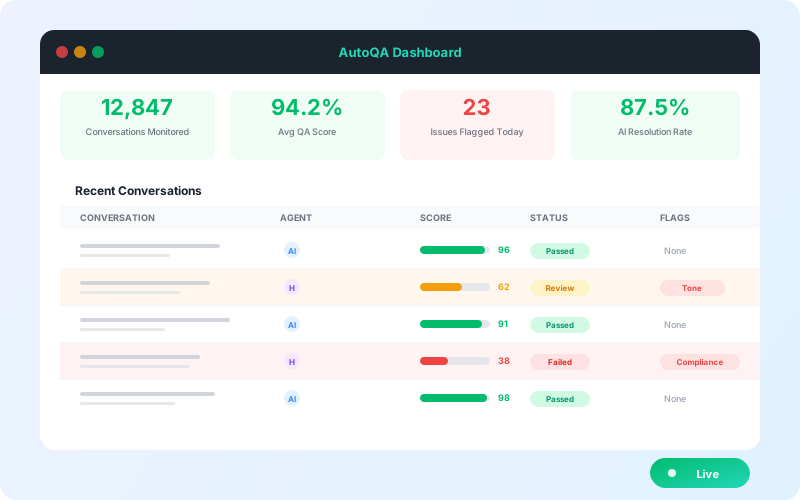
Auto-QA, short for automated quality assurance, is the use of AI to automatically evaluate and score customer support conversations against a quality rubric, across voice, chat, email, and tickets. It replaces the traditional manual model, in which a team lead hand-scores a small random sample of interactions, with continuous scoring of every conversation a team handles.
This glossary defines Auto-QA. For the product that scores 100% of AI and human conversations on your helpdesk, see AutoQA product.
Related product hub: Voice AI for grounded voice AI with contextual conversations and seamless handoff.
For the commercial call monitoring overlay (full-coverage QA on the phone system you already have), see call monitoring software.
In a manual QA program, reviewers typically grade just 2 to 5 percent of conversations. That sample is too small to be representative, it is slow to produce, and it is prone to bias in which tickets get pulled. The interactions that most damage customer satisfaction, along with quiet policy violations and the best coaching moments, are usually never reviewed. Auto-QA closes that gap by scoring 100 percent of conversations, applying the rubric consistently, and surfacing the handful that genuinely need a human reviewer's judgment.
How automated quality assurance works
A modern Auto-QA system ingests the full transcript of each interaction and evaluates it against scorecard criteria such as greeting and tone, issue identification, accuracy of the resolution, policy and compliance adherence, and closing. Large language models interpret the conversation semantically rather than by keyword matching, so they can recognize whether an agent actually resolved the issue, not just whether they used the right phrases. The strongest systems ground every score in the transcript and the company's knowledge base, and show the evidence behind each rating, so the score is explainable instead of a black-box number. This grounding is what prevents an AI from inventing a violation that did not occur.
Auto-QA vs. manual QA sampling
Manual QA | Auto-QA | |
|---|---|---|
Coverage | 2% to 5% of conversations | Up to 100% of conversations |
Time to find a problem | Days to weeks | Minutes to hours |
Consistency | Depends on reviewer calibration | Same rules applied to every conversation |
Channels | Usually the easiest channel to review | Voice, chat, email, and tickets |
AI agent conversations | Rarely reviewed | Scored with the same rules as human ones |
Best at | Nuance, context, and coaching conversations | Patterns, compliance misses, and outliers at scale |
Auto-QA does not make human reviewers redundant. It changes where they start. Instead of pulling a random handful of tickets, reviewers begin with the conversations the system flagged, check the scores they disagree with, and spend the time they save on coaching.
What an Auto-QA scorecard checks
Most teams start with 5 to 10 rules, written the way a QA lead would explain them to a new reviewer. Common categories, with an example rule for each:
Compliance and verification: the agent verifies the customer's identity before discussing account details.
Answer accuracy: the resolution matches the current help center article or policy.
Process steps: refunds above the approval limit are escalated, not issued directly.
Tone and empathy: the agent acknowledges the customer's frustration before troubleshooting.
Resolution: the customer's original question is answered, not just a related one.
Closing: the agent confirms the next step and when it will happen.
Give each rule a severity, so a missed disclosure counts as an automatic fail while a weak sign-off is only a coaching note. For more examples, see how teams write QA rules in plain English that both human reviewers and AI scorers can apply.
How to roll out Auto-QA in four steps
Connect it to the help desk you already use, so it reads conversations where they happen and there is nothing to migrate.
Write your first 5 to 10 rules, starting with compliance items and the mistakes that most often lead to escalations.
Run it alongside manual QA for the first few weeks. Compare scores item by item, and rewrite any rule where the AI and your reviewers keep disagreeing.
Send flagged conversations to human reviewers, and turn recurring failures into coaching topics, knowledge base fixes, and changes to your AI agent.
If you are building the QA program itself, from scorecard to calibration, our call center quality assurance checklist covers each step.
Why Auto-QA matters
Auto-QA turns quality assurance from a sampling exercise into a complete, real-time signal. Because every conversation is scored, leaders can spot trends across agents and teams, catch compliance risk early, and connect quality directly to outcomes like CSAT, resolution rate, and handle time. Just as importantly, comprehensive scoring feeds agent coaching: managers can focus 1:1s on the themes that actually move performance, backed by real examples rather than a thin sample. The result is a faster, fairer, and far more complete view of support quality than manual review can offer.
Auto-QA is increasingly considered table stakes for AI-era support operations, both for human agents and for AI agents, whose answers also need continuous, grounded quality checks.
Where Auto-QA still needs people
Auto-QA is strongest at coverage and consistency. It is weaker when the right call depends on context the transcript does not show, such as an exception a manager approved by phone, or a customer whose account history explains an unusual request. Keep people on three jobs: reviewing disputed and high-impact scores, updating the rules when policies change, and running the coaching conversation itself. The system finds the moments. Your team leads still change the behavior.
To see automated QA running on your own conversations, explore IrisAgent AutoQA, which scores 100% of AI and human conversations against rules you write in plain English.
Frequently Asked Questions
What is automated quality assurance in customer service?
Automated quality assurance, often shortened to Auto-QA, uses AI to score customer support conversations against a quality rubric automatically. Instead of a team lead hand-scoring a small random sample, every call, chat, email, and ticket is checked against the same rules, such as identity verification, answer accuracy, tone, and resolution, and the conversations that fail are flagged for a human reviewer.
What is the difference between Auto-QA and manual QA?
Manual QA reviews a sample, typically 2% to 5% of conversations, so most problems are never seen and results depend on which tickets were pulled and who scored them. Auto-QA scores up to 100% of conversations with the same rules every time and surfaces problems in minutes to hours instead of days. Most teams use both: Auto-QA for coverage and consistency, and human reviewers for disputed scores, calibration, and coaching.
Does Auto-QA replace QA analysts?
No. Auto-QA replaces the random sampling step, not the people. QA analysts move from pulling and scoring tickets to reviewing flagged conversations, settling disputed scores, keeping the rules current as policies change, and coaching agents on the patterns the system finds.
Loading the form. Prefer email? Reach us at info@irisagent.com or call +1 617 249 3312.